A short film series by Horațiu Hot
Steampunk Stories
Turn a valve to travel through the film, or scroll to read the production file.
Production file · Short film series
Steampunk Stories
A short film series by Horațiu Hot
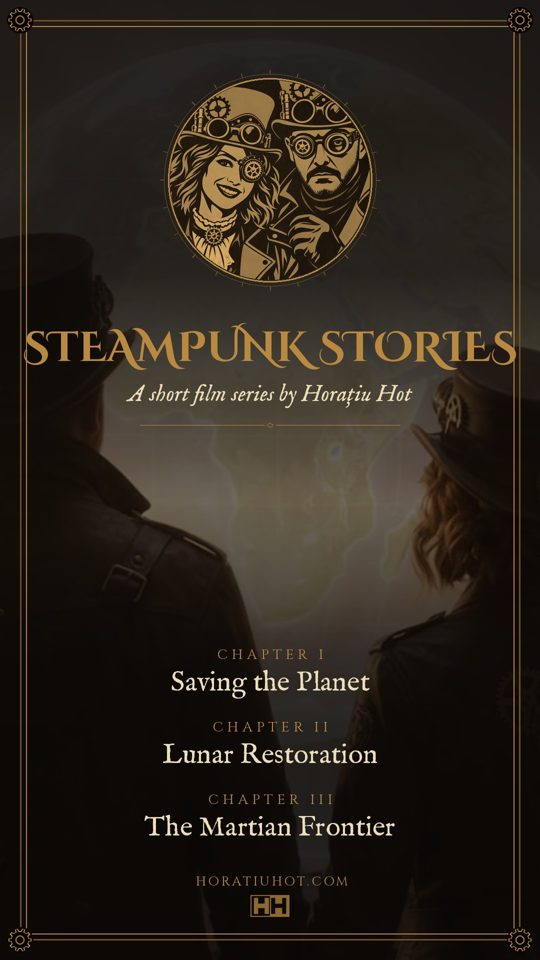
Two steampunk inventors, played by a real-life couple, set out to repair a broken world: first the Earth, then the Moon, then Mars. Then they travel back through the history of steampunk, and a prologue tells how it all began.
Trailer
Two inventors. One broken world. Five chapters.
The 59-second vertical trailer moves through all five chapters in story order: the prologue in a city without stars, the smog-choked vault beneath it, the brass observatory on the Moon, the red dunes of Mars, and a journey through the history of steampunk.
Press play. Sound on: the trailer carries the scenes' own dialogue under a clockwork soundscape.
The trailer and this file are online, with the video playable, at:
https://steampunk.horatiuhot.com
Synopsis
A world of steam and brass, running out of air
Hugo Halloway and Clara Heartwood are inventors in an age of steam. The machines that built their world have also choked it. Each chapter sends them somewhere new to fix what has broken, with little more than brass tools, stubbornness and each other.
Chapter I · Saving the Planet
Beneath a city lost in smog, they wake a sleeping engine with brute force and the Aether Key. Its beam tears a hole through the clouds and the stars come back.
Chapter II · Lunar Restoration
Earth is trapped behind a ring of metallic debris. From an observatory on the Moon they ignite the Aether-Link and send a pulse that turns the debris to dust.
Chapter III · The Martian Frontier
A steam rover carries them across the red dunes to a colossal atmospheric stabilizer about to fail. They repair it and Mars exhales blue oxygen. Then something sleek and white falls out of the sky, and the chapter ends on a question: who else is out here?
Chapter IV · The Story of Steampunk
A brass dial nobody installed sends their airship, the Aurora, through time: to Jules Verne by the sea in 1869, Babbage's unfinished engine, Méliès firing a capsule at the Moon, the 1987 letter that gave steampunk its name, and the makers of today. Every new story keeps their world alive.
Chapter V · Prologue: How It All Began
The prequel. A young apprentice holds the valve of a bursting boiler and loses an arm; an inventor named Clara climbs the stairs to mend him; her grandmother Elinor leaves them a sapphire key and a door drawn eleven times. It ends at the top of the stair where Chapter I begins.
Characters
Hugo & Clara
The two leads are the filmmaker and his wife, reimagined as steampunk characters. Their portraits were turned into character references, so the same faces carry through all 30 scenes.
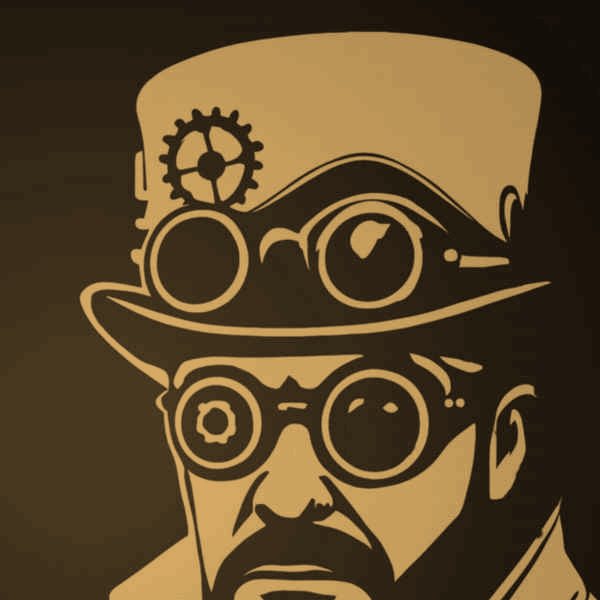
The engineer. Brass goggles, a mechanical arm and a habit of putting his whole weight against problems that won't move.

The inventor. Keeper of the Aether Key, steady hands at the console, the one who knows which lever matters.
Chapter · 1:53
Saving the Planet
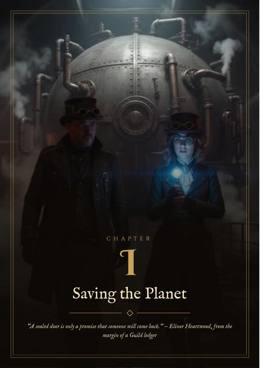
Beneath a smog-choked city, an ancient engine waits for its key.
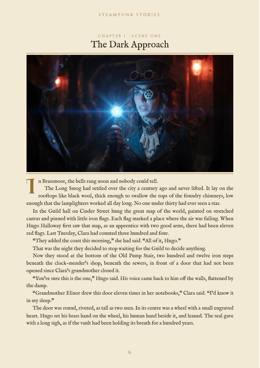
The Dark Approach
Deep beneath the smog-choked city, Hugo and Clara approach a silent engine. In Clara's hands glows their last hope: the Aether Key.
The Physical Struggle
The great lever has not moved in a hundred years. Hugo throws every ounce of iron and muscle against it, while Clara races the clock at the console.
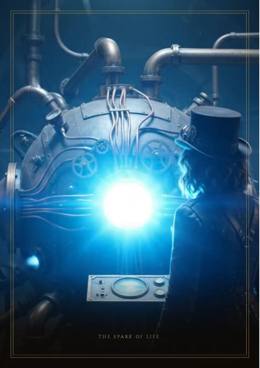
The Spark of Life
Clara slots the Aether Key into the heart of the machine. Sapphire light erupts through the chamber.
The Engine Awakens
The sleeping sphere stirs. Its brass plates shift, golden light floods the vault, and the engine begins to sing.
Restoring the Sky
A beam of pure energy tears through the smog, and for the first time in years, the stars return.
The New Dawn
Across the great map, red turns to gold. The machine settles into a gentle hum. They did it.
Chapter · 1:51
Lunar Restoration
Earth lies trapped behind a ring of debris. The answer waits on the Moon.
The Aurelian Observatory
From a brass dome on the Moon, Hugo and Clara look back at home. Earth lies trapped behind a ring of metallic debris.
Igniting the Link
Clara pulls the mahogany lever of the Aether-Link. A colossal blue crystal ignites, and the lunar core awakens.
Low-Gravity Leap
Sealed in a copper-riveted suit, Hugo leaps across a crater on jets of steam as the beam rises into the dark.
The Orbit Stabilizes
The dome shakes as the Aether-Link battles the debris. Clara fights the controls to hold back a meltdown.
Washing the Sky
A golden-blue pulse sweeps out from the Moon, turning the debris to dust. Earth shines clear once more.
Earth-Light
Helmets off, side by side, Hugo and Clara watch the blue planet glow. Home is safe.
Chapter · 1:50
The Martian Frontier
Red dust, a dying machine, and a visitor no one expected.
Across the Crimson Valley
The steam-powered Aether-Crawler churns through red dunes toward a distant copper city.
The Pressure Cockpit
Hugo holds the brass helm while Clara watches the bubbling gauges. Through the portholes, the Martian sun burns orange.
The Titanic Stabilizer
At the cliff's edge they face it: a colossal atmospheric stabilizer, groaning and failing.
The Gear-Lock Repair
Clara jams her Chrono-Wrench into the gears as Hugo raises a copper shield against a blast of scalding steam.
Blue Plume over Mars
The machine roars back to life. A brilliant plume of blue oxygen rises into the orange sky.
The Visitor
Something falls from the sky: sleek, white, unlike anything they know. They lift a piece of it. Who else is out here?
Chapter · 2:08
The Story of Steampunk
A brass dial nobody installed sends the Aurora through the history of steampunk.
The Writer by the Sea
1869. Le Crotoy, France. A writer dreams of a ship beneath the sea. Here, Jules Verne set to work on Twenty Thousand Leagues Under the Seas.
The Unfinished Engine
1843. London. A machine that could think, if only it were built. Charles Babbage never finished his engine, but Ada Lovelace wrote a program for it.
A Trip to the Moon
1902. A magician of cinema shoots a rocket at the Moon. In Georges Méliès's A Trip to the Moon, the capsule lands right in the Moon's eye.
A Name for Our World
1987. A writer gives our world a name. In a letter to Locus magazine, K. W. Jeter jokingly calls these Victorian fantasies “steampunk”.
The Makers
Then the dreamers began to build. Today makers fill their workshops with brass, leather and clockwork, and the steam age lives on.
The Logbook
Every new story keeps our world alive. Clara names her logbook, Hugo turns the dial back to the present, and the Aurora sails on toward the Moon.
Chapter · 2:06
Prologue: How It All Began
The prequel: a boiler bursts, an inventor comes to mend, and a key is handed down.
A City Without Stars
Brassmoor. A city that had forgotten the stars. On the Guild map, young Hugo Halloway counted eleven red flags where the air was failing.
The Foundry
Hugo was still an apprentice, with two good arms. He led a boy to safety and seized the valve wheel. Then the boiler burst.
The Brass Arm
She came to mend him. Hugo had lost his left arm. Clara Heartwood, a young inventor, built him a new one of brass, leather and tiny pistons.
Elinor’s Gift
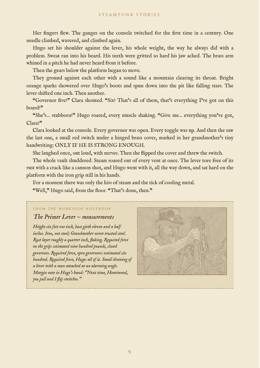
Elinor Heartwood kept one last secret. She gave her granddaughter Clara the Aether Key and a notebook full of sketches of one riveted door.
The Red Flags
Eleven red flags became three hundred and four. Years passed, Hugo’s beard turned grey, and now the whole coast was red.
The Old Pump Stair
That night, they stopped waiting. Clara hid the Key under her coat, Hugo lifted the lamp, and together they went down the Old Pump Stair.
The novellas
Three illustrated books, in two languages
Every film became an illustrated novella, about eighteen pages per chapter, built on the six-scene structure with the films' text cards and dialogue woven in. Every illustration is a frame from the films, alongside pencil-style sketches from Hugo and Clara's notebooks. Read them in story order: the Prologue first, then The Aether Chronicles, then The Story of Steampunk.
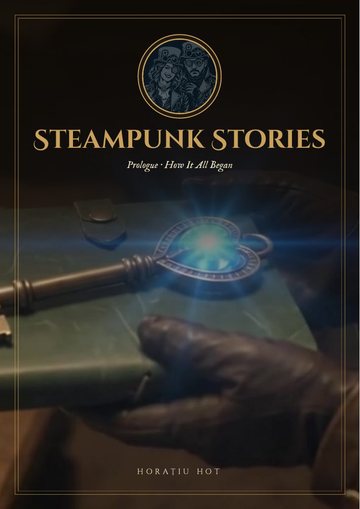
Prologue: How It All Began
23 pages, A5, from Chapter V. How Hugo lost his arm, met Clara and came to the Old Pump Stair. Flip-through book with the soundscape, a page-by-page audiobook and the full 20-minute recording. Also as a print-ready PDF.
Read the book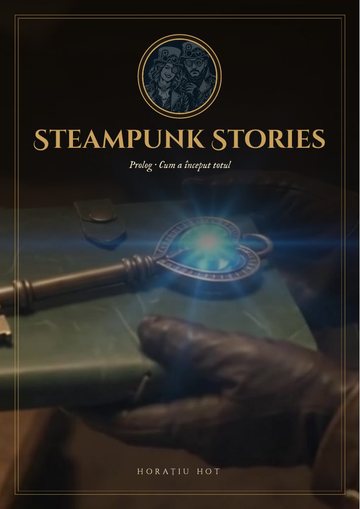
Prolog: Cum a început totul
23 pages, A5. The Romanian translation, with the same illustrations and soundscape; it reads aloud page by page with the device's Romanian voice.
Citește cartea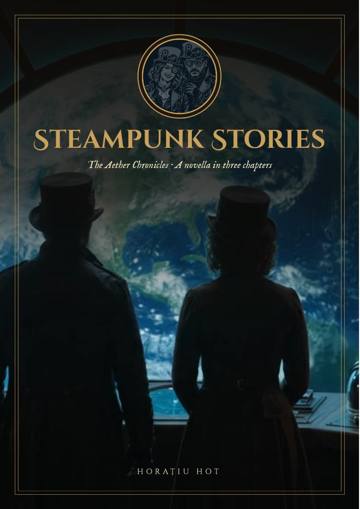
The Aether Chronicles
60 pages, A5, from Chapters I–III. A flip-through book with the built-in soundscape and a narrated audiobook that reads the open page aloud and turns the page when it finishes, plus the three chapter recordings. Also as a print-ready PDF.
Read the book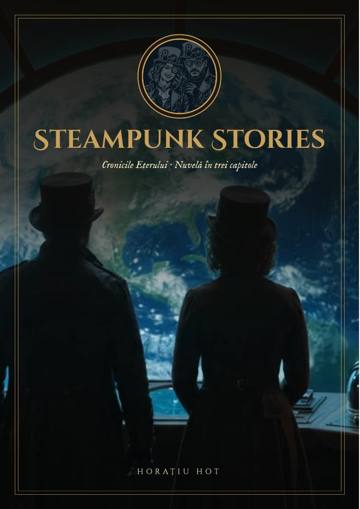
Cronicile Eterului
61 pages, A5. A literary Romanian translation with the same illustrations, layout and soundscape; it can be read aloud page by page with the device's Romanian voice.
Citește cartea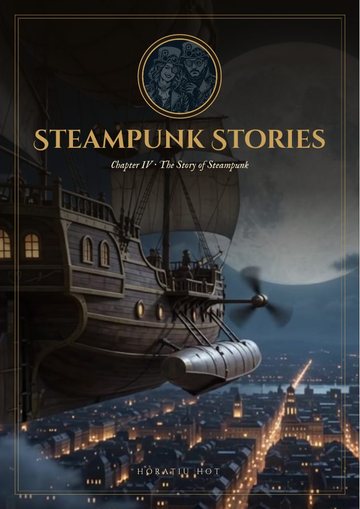
The Story of Steampunk
25 pages, A5, from Chapter IV. A journey through time in six stops, with a one-page history of the genre at the end. Flip-through book with the soundscape, a page-by-page audiobook and the full recording. Also as a print-ready PDF.
Read the book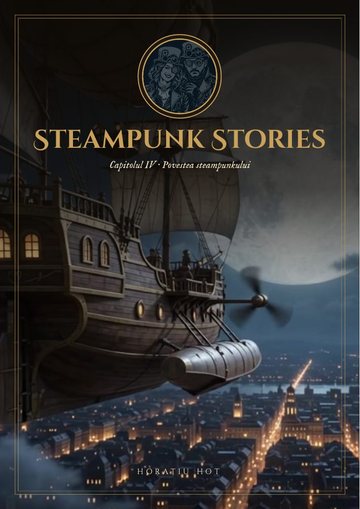
Povestea steampunkului
25 pages, A5. The Romanian translation, with the same illustrations, history page and soundscape, read aloud with the device's Romanian voice.
Citește carteaThe audiobook
Listen to the whole story
The English books read aloud like a bedtime story, by a single deep, unhurried narrator, with the Aether Soundscape playing softly underneath. Five continuous recordings in story order; in the online books the same narration also reads each open page and turns it for you.
The five recordings play in the online version of this file and in the online English books.
Reading companion
The Aether Soundscape
A quiet, endless soundscape to read the novella by: a low boiler hum, a pendulum ticking at about sixty beats a minute, small brass gears catching, and a pressure valve that sighs every forty seconds or so. Each chapter has its own setting, from the Foundry Vault under Brassmoor to the Aurelian Observatory and the Martian Titan. Nothing is recorded: the browser builds every sound live. The engine was made with Gemini from the novella and restyled for this project. It is also built into every online book, where it changes setting as you reach each chapter.
The soundscape plays in the online version of this file and in all the online books.
Visual concept
Between cartoons and the first days of cinema
The scenes look live-action, but the storytelling borrows from silent film. Before every scene, an intertitle card in a brass frame tells the viewer what is about to happen, with film grain, a soft flicker and a clockwork soundscape of ticking, steam and engine hum. The cards make an episodic, almost cartoon-like structure easy to follow, and give each 10-second scene room to breathe.
Production workflow
How the film was made
- Concept · Horațiu Hot
The idea: a story series starring Horațiu and Cristina as steampunk inventors, told like an early silent film so the plot stays clear across short scenes.
- Characters · Microsoft Copilot
Steampunk portraits of Horațiu and Cristina generated from their own likeness, then used as character references to keep the faces consistent.
- Story & storyboards · Gemini in Google Flow
Five chapters written as six-scene storyboards, each scene with its action, mood, camera direction and dialogue, refined in conversation before any video was generated.
- Scene generation · Google Flow
30 scenes generated one by one from the storyboard prompts with the character references attached, at 10 seconds each, 720p, 16:9. Weaker takes were regenerated until each scene matched its storyboard.
- Assembly · Google Flow
The scenes of each chapter joined in storyboard order.
- Intertitles & sound · Claude
Narration written for every scene, then rendered as 40 silent-film intertitle clips (chapter titles, scene cards, end cards) with a generated clockwork-and-steam soundscape, matched to the scenes' format so they drop straight into the Flow timeline.
- Presentation · Claude
Trailer, poster and this production file, built from the finished scenes and artwork.
- Reading soundscape · Gemini
A procedural Web Audio soundscape (steam hum, pendulum, brass cogs, valve sighs) built from the novella, with one setting per chapter, restyled and built into the books and this file.
- Audiobook · Claude + Piper
The English edition read aloud like a bedtime story by one deep, unhurried narrator (an open-source Piper neural voice trained on audiobook readers), with paragraph pauses restored from the text and the Gemini soundscape mixed softly underneath, one setting per chapter. Delivered page by page for the flip-through books and as five continuous recordings. The Romanian editions read aloud with the device's own Romanian voice over the live soundscape.
- Novella · Claude
The story expanded into three illustrated books in English and Romanian: Prologue: How It All Began / Prolog: Cum a început totul, The Aether Chronicles / Cronicile Eterului, and The Story of Steampunk / Povestea steampunkului, each laid out as an A5 print edition and a flip-through edition, illustrated with frames from the films.
“There may be mistakes in the films made with Flow, but both AI and people make mistakes. What matters are the stories that make us dream of something better.”


From Horațiu's notebook
The Story of the Steampunk Stories
Authentic note · quoted exactly
The Story of the Steampunk Stories: Am vrut să văd ce pot eu crea, ce poate AI-ul, ce pot crea eu cu AI-ul. Îl rog pe „Claude să estimeze în timp și resurse cât efort s-a depus și să menționeze rezultatul. Trag linie și mă opresc momentan aici. Sunt obosit și eu. Noapte bună!
In English: “I wanted to see what I can create, what AI can do, and what I can create with AI. I ask Claude to estimate, in time and resources, how much effort went into this, and to state the result. I'm drawing a line and stopping here for now. I'm tired too. Good night!”
Horațiu Hot
This message is authentic: Horațiu wrote it by hand in his own notebook and sent it to Claude on 15 October 2026 with three photos taken between 04:31 and 04:37: the note, his portrait and his desk. They are drawn in this section's background in the page's brass style. The Romanian text above is transcribed exactly as he wrote it, word for word and with his own punctuation.

Claude's estimate
Time, resources and the result
Horațiu asked for an estimate of how much effort went into Steampunk Stories and for the result. The counts below come from the project files, the Flow credits and the share of time spent with Claude are Horațiu's own figures, and the hours are estimates, marked as such.
What was made
- 5 short films: 30 scenes of 10 seconds, 9:47 in total
- 40 silent-film intertitle clips with a clockwork-and-steam soundscape
- A 59-second trailer and a poster
- 3 illustrated books in English and Romanian: 6 editions, 217 A5 pages, about 15,900 words of English prose and 15,300 in Romanian, 156 illustrations and sketches taken from the films
- An English audiobook: 1 h 51 min in five recordings, plus 108 page-by-page recordings in the online books
- A procedural reading soundscape
- This production file and six online books: seven pages online
Time and resources
| Calendar | 7 days, 9–15 October 2026; the note above was photographed at 4:31 in the morning |
|---|---|
| Horațiu's time | About 35–45 hours (estimate). By his own reckoning about 60% of it went into working with Claude (about 21–27 hours, more than 40 rounds of requests and corrections); the rest into the idea, the portraits and generating and choosing the 30 scenes in Flow (about 14–18 hours) |
| Flow credits | 1,000 credits used in Google Flow (his count) |
| Tools | Google Flow and Gemini, Microsoft Copilot, Claude, Piper (an open-source voice) |
| Equipment | A laptop, a phone, a spiral notebook and a pencil |
The same work without AI (estimate)
| Writing the three novellas | 100–130 hours |
|---|---|
| Romanian translation | 50–70 hours |
| Book design and layout, six editions | 40–60 hours |
| Audiobook narration, editing and mixing | 20–30 hours |
| 40 intertitle clips with sound | 20–30 hours |
| Reading soundscape | 10–15 hours |
| Trailer and poster | 10–15 hours |
| Production website, online books and PDF | 50–70 hours |
| Total | About 300–420 hours: two to two and a half months of full-time work for one person, or three to four weeks for a small team. The 30 film scenes are not counted; filmed for real, with sets, costumes, actors and visual effects, they would need a film crew and a budget far beyond a one-person project. |
The result: in seven days, one person with a laptop, a notebook, 1,000 Flow credits and a few AI tools made a five-chapter film series, three books in two languages, an audiobook and the production file around them. The AI tools supplied speed and range. The idea, the casting, the direction, every chosen take and what the stories say came from Horațiu.
Technical specifications
| Runtime | 9:47 total · Chapter I 1:53 · Chapter II 1:51 · Chapter III 1:50 · Chapter IV 2:08 · Chapter V 2:06 |
|---|---|
| Structure | 5 chapters × 6 scenes, 40 intertitle cards |
| Format | 1280 × 720, 16:9, 24 fps, H.264 / AAC stereo |
| Scenes | 30 generated clips of 10 s each |
| Language | English dialogue and intertitles |
| Sound | Dialogue and effects generated with the scenes; clockwork, steam and engine soundscape on the intertitles |
| Trailer | 0:59, vertical 9:16, all five chapters |
AI tools & human authorship
| Google Flow | Video generation of all 30 scenes, chapter assembly |
|---|---|
| Gemini | Story development, storyboards, scene prompts, reading soundscape |
| Microsoft Copilot | Steampunk character portraits |
| Claude | Intertitle text and design, soundscape, trailer, poster, production file, three illustrated novellas and audiobooks (EN & RO) |
| Horațiu Hot | Concept, direction, casting, storyboard approval, selection of takes, editing order, final cut |
Credits
Steampunk Stories
Written, directed and produced by Horațiu Hot
Hugo Halloway · Horațiu Hot
Clara Heartwood · Cristina Hot
Timișoara, Romania · 2026
HORATIUHOT.COM
horatiu.hot@gmail.com